Dare to Dream Small
I appreciate having the opportunity to share a few words with you in this critical and bittersweet moment. I wanted to take some time to tell you how I came to the fledgling Pine Hill Community Center ten years ago, first as a participant, then as a volunteer, and then as its first Director. It feels important to relate the story to you because it’s kind of funny, and because my story is, in fact, anyone’s story. I found the Community Center by sheer accident, with no other desire than to attend a program here; but what I got was an opportunity to engage in meaningful and surprising ways. My story is a story of connections.
I would also like to make a few acknowledgments to people who have helped to make this place what it is. Then I will conclude by reflecting a little on the future; my own future and the Center’s. In many ways I have reared the Center over these years; and in many ways the Center has reared me. Tonight, we are committing one another into other hands. I can not say exactly why, but this leave-taking seems somehow necessary for our mutual growth. It is a joyous leave-taking, so that the Center and I may continue the work that we have so painstakingly accomplished in each other. But, since I am still the Director for another day, I wish to give a few words of direction as I release the line.
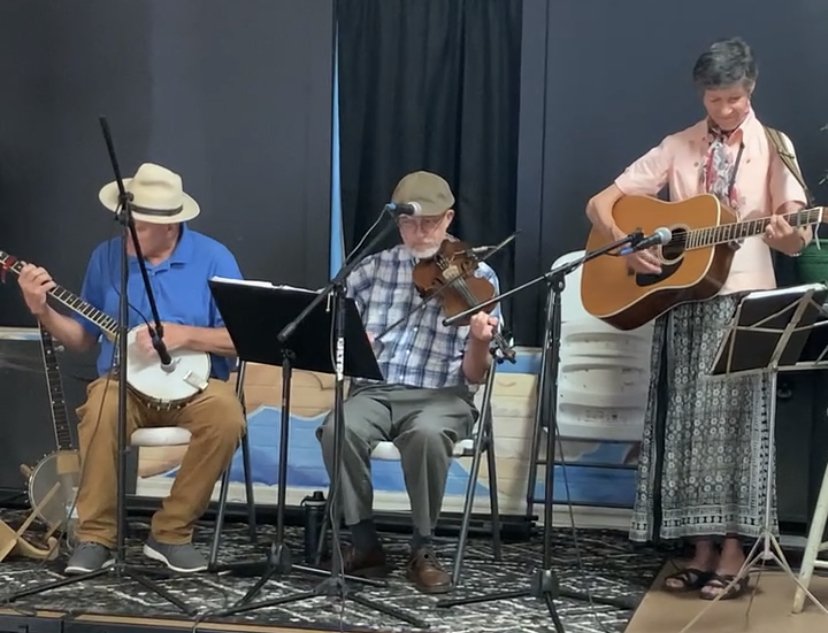
When I first showed up here I was, by all accounts, not Executive Director material; indeed, if you had asked me to be one I would have promptly declined. I came to the Community Center as a guitar toting bum to one of the best open mic nights I have ever experienced. It was there that I first met a host of people who would soon become a huge part of my life: Jim Rauter, Devin Angus, Laurie Baratta, Henry Hermann. Jim later helped me build a house in Halcott; Devin and Henry and I formed the most remarkable band I’ve ever performed in; Laurie would later help me land a job.
At the time I was living in a tipi which I had pitched on Linda Rogers’ farm up Broadstreet Hollow. I did home care for a local family struggling with AIDS, work I had taken at the prompting of friends at Zen Mountain Monastery. When the person I was caring for died I re-accepted an administrative position in a nursing home down in Liberty. Because living in a tipi and showing up to a job well-groomed are not mutually agreeable, I decided to move into one of Len’s apartments for the same reasons that many of us do: it was readily available and I could afford the rent.
When the open mic night began to lose steam, I volunteered to host a song circle at the Community Center. Polly would always show up and listen. She was quiet, and I was shy, but I clearly remember being very intrigued by her. I had no clue that she would become such a monstrous and wonderful presence in my life; no idea how much her brilliant spirit and ways would touch, influence and teach me over these years.
Laurie, who was Acting President of the Board at the time, informed me that the Center had received a grant – written and won by Eve Smith – to hire a Program Director to run a summer youth program. She asked me if I would be interested. I was fairly miserable at my position in Liberty so, after crunching a few numbers and deciding that I could get by with the pay cut, I told her that I was, in fact, interested; what the hell. It sounded fun and it would give me the summer to look for another job. I had to wear a tie to work, so I decided to be professional and keep it on when I showed up to my interview with the Community Center Board, which at that time consisted of Florence, Polly, Laurie, Jackie Persons, Joanne Rogers and Marge Lloyd (I hope I’m not missing anyone). Jackie took one look at me and promptly commanded me to loosen it. It was then that I knew that this job and I could be a very good fit, indeed! So I lost the tie, and they hired me that very evening.
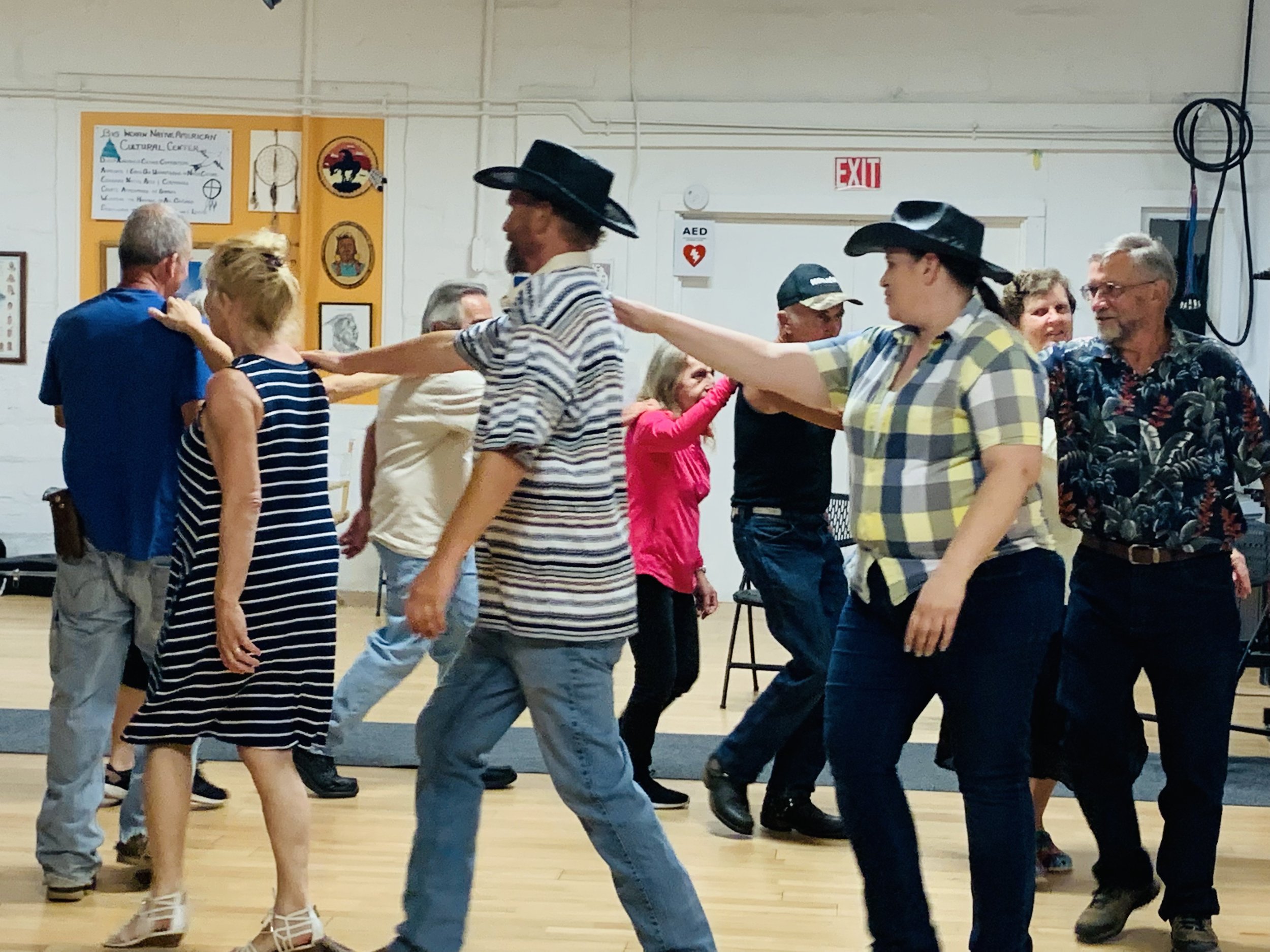
Mine is just one storyline among so many. When I look around this building everything I see tells a story; and every story has its cast of characters. The wood for this stage was donated by Steven Wadler, picked up by Dennis Havel on a cold winter’s day, and made into a stage by Dennis, Jeff McNutt and a few others from the Panther Mountain Pickers. How many countless people have graced this stage, including some five years of Cabaradios. Dennis, too, was largely responsible for hanging the drop ceiling throughout the building when it first became a community center. That’s Jim Nevin’s light from his studio upstairs. Steve Bernsohn painted the floor; Misty Esposito painted the radio room in the back; Tom Meecham built the gate to the computer room; Jaimie DeForest threw the pot on my office windowsill; Hal Alskive gave us that kiln; Michael Boyer got us the other one. There’s Susan and Melissa’s target, which reminds me of all the children they taught archery to: James, Frederick, Chris, Kasey, and a host of others. I remember also that first group of Community Center kids, all little punks happily enjoying Halloween games, shark attack, tag, kickball and Twister competitions here in this room.
Even the piles of papers in my office tell a story, many of them stories that stretch far beyond these walls: the folks at the Ashokan Stream Management Project; the dear Gloria Lipton from the Ulster County Youth Court; and Peter Manning’s contribution “Building Your Byway from the Ground Up.” Truly, this place belongs to a huge family of people.
I have more debts of gratitude to pay than is possible tonight. I would like acknowledge and thank everyone who was involved in founding the Pine Hill Community Center back in 1999. It is through their hard work, vision and generosity that this place exists. I want to thank those early Board Members, and all Board Members since. I have many colleagues who work in the not-for-profit sector and I have heard horror stories about really dysfunctional Boards. Without fail the Community Center Board of Directors has been supportive, honest, respectful, dedicated and generous. I’ve learned a great deal from all of you and have thoroughly enjoyed working with you.
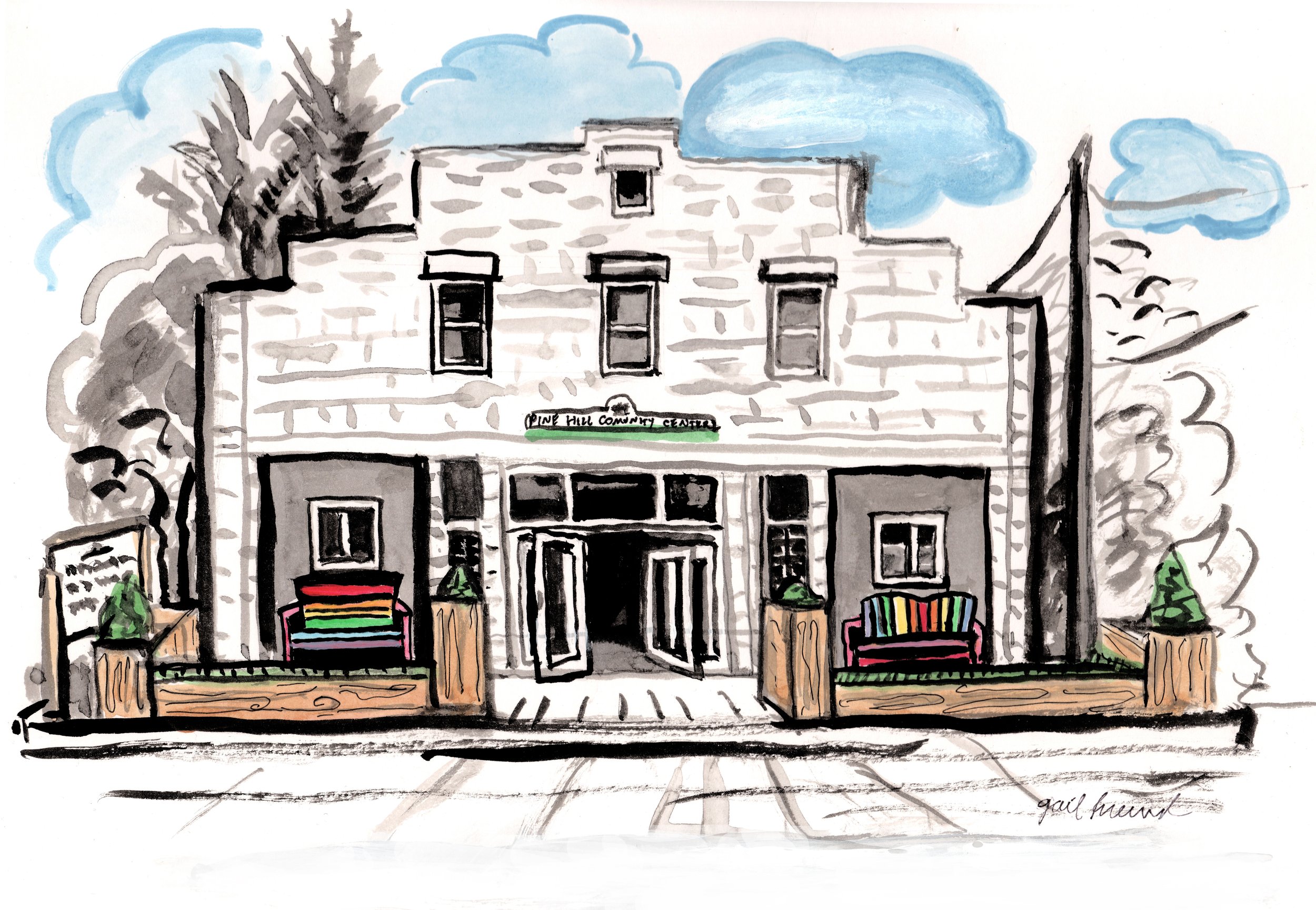
My greatest, the Center’s greatest, debt of gratitude goes out to two people who have not simply been friends of the Pine Hill Community Center, but parents. For eight years they leased this building to us for $1 a year, all the while paying the property taxes and donating significant funds for the Center’s operations. In 2008, they outright donated the building and grounds of 287 – 289 Main Street to the organization. Their devotion to the vision of this place has been as big as their generosity; together they’ve not only put their money where their mouth is, but their backs, their sweat and their faith. They are Florence and Bernie Hamling, please give them a hand.
Finally, I’d like to take a few moments to share some thoughts about the Center; things I feel are necessary to keep in mind as all of you bring it forward into the future. As organizations grow, a danger grows with them. They necessarily lose the excitement of newness; they can become more cemented, more officious, more professional, less connected to the community which has birthed them. I would warn both the Board, the new Director and the residents of this community to be vigilant in remembering that it is the Center’s purpose not to provide a professional or social service to a passive clientele, though it will do this from time to time. For the past year the Board has been working on creating a strategic plan; re-working our vision and mission statements was a big part of this process. Though we still do not have a mission statement that I would rest comfortably with (the Board is going to have to attend to this) the vision statement is a strong one; it reads, simply: our vision is for an open and engaged community in the Central Catskills. “Engaged” says it all. We do not want to provide a professional service, but an opportunity to engage.
This place has been given to us as a great experiment, a place to rally around and to care for. It has been given to us as a means by which we might offer what we have to others, and by which we might receive the help and fellowship we need. For myself and so many others, this place has proven time and again that we often get what we need precisely when we are giving what we can. Neither the Board nor the Director can do this for us; we must each take the risk of engagement, and the risks are indeed many. It has been my experience, however, that in the end, in an engaged community we all receive life, one from another. St Paul describes the congregation as many parts of one body. He says:
Suppose the foot were to say, ‘Because I am not a hand, I do not belong to the body,’ it belongs to the body nonetheless. . . . The eye can not say to the hand, ‘I do not need you,’ or the head to the feet, ‘I do not need you.’
When I arrived here a decade ago, all I wanted was a good open mic. I got so much more. It is my hope that everyone who enters this place, whatever they are initially looking for, continue to find within these walls a family in which they might act, in which they might give of themselves, in which they might discover the gifts they bear, receive the gifts of others, in which they might learn, as I continue to learn, that, in the end, it all comes down to connections; to love.
In a week I will be entering into a new and unknown future. I will forego my title as Executive Director for the title of Starving Student. This chapter of my life has come to a decisive end. But the story will continue. It is my hope, it is my promise, that I will not forsake the work done here; the gifts and support given to me over these years; the lessons learned and the lessons not yet mastered. For me, this is not a leave-taking; rather, it is a further exploration into all the things that have inspired and challenged me over the past ten years. As I delve into the roots of my faith I will continue to engage community not only as a nice afterthought to my theological studies, but as the very heart of the matter. Christians have found it best to speak of God as Trinity, as a relationship, as communion; one grand economy within which we all participate. This great communion is the final truth of our lives whether or not we accept it. It is what judges us, what heals us, what corrects us, what fashions us, what upholds us, what receives us back. As I look around this building I am convinced of this. The sign outside says “dare to dream big;” but I say “dare to dream small.” It’s Jim’s light, Dennis’ stage and ceiling, Steve’s paint on the floor; these little things, these small gestures and gifts, these particular acknowledgements of the mutuality of our lives are what make this place what it is. Let us not forsake it; may each of us take care of it, day after day.